
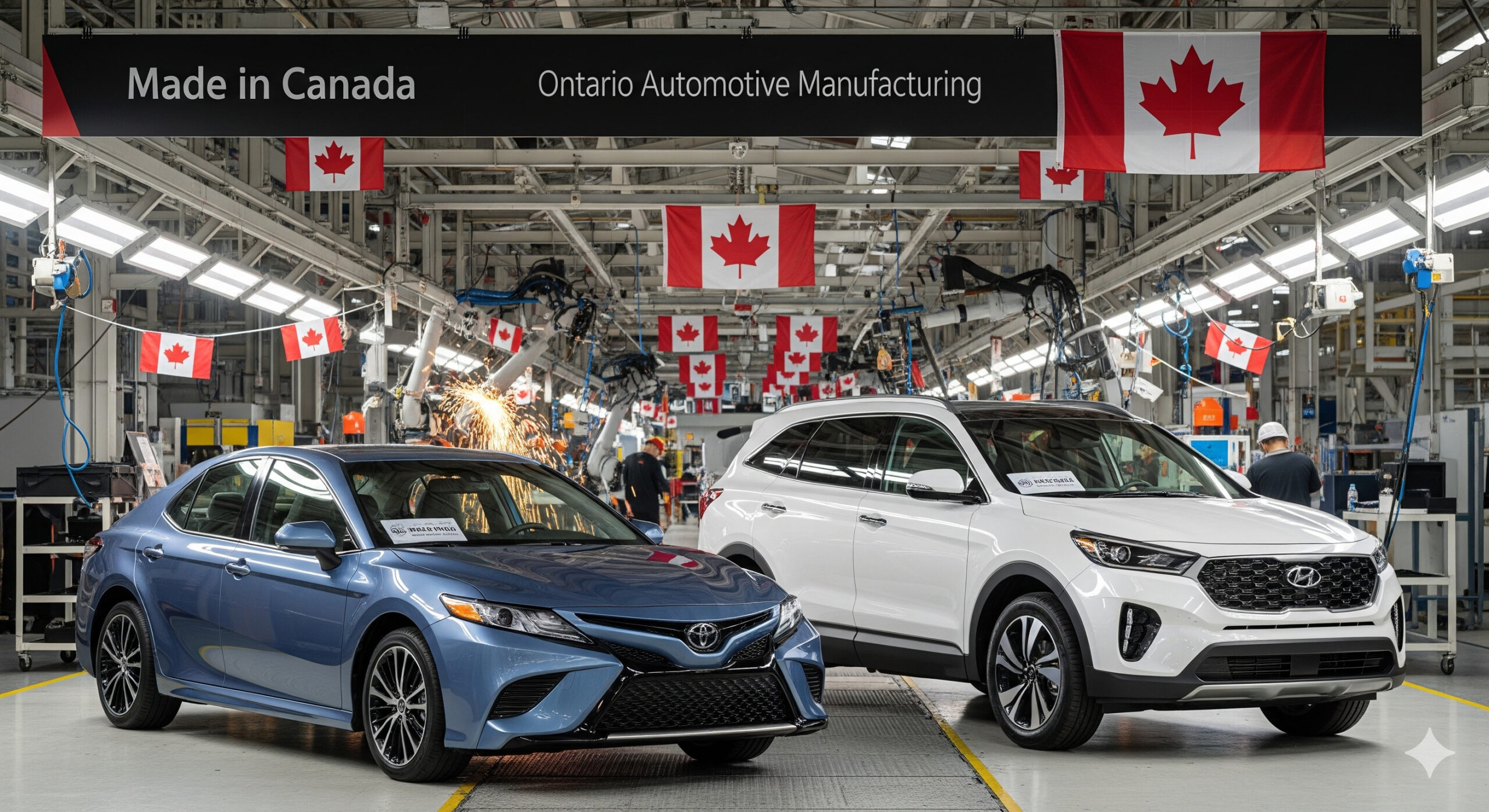
Canada can help fight back against the US by focusing on buying non-American cars and trucks.
A significant shift in Canadian consumer behavior toward Japanese and Korean vehicles (like Toyota, Honda, Hyundai, and Kia) would have a profound and paradoxically damaging effect on the United States, primarily due to the deep integration of the North American supply chain.
Because the auto industry operates as a single continental ecosystem, a “non-American” car is often more “American” than it appears.
Significant Loss of U.S. Parts Exports
The U.S. and Canadian auto industries are so intertwined that parts often cross the border seven to eight times before a vehicle is finished.
- The “50% Rule”: Currently, more than half of the components in Canadian-built vehicles originate in the U.S.
- The Impact: If Canadians stop buying vehicles from the “Big Three” (GM, Ford, Stellantis), U.S. parts manufacturers in states like Michigan, Ohio, and Indiana would see a massive drop in demand, potentially leading to layoffs and factory closures in the American Midwest.
Disruption of “Made in America” Japanese/Korean Cars
Many Japanese and Korean cars sold in Canada are actually manufactured in the U.S. (e.g., the Toyota Highlander is made in Indiana; the Honda Odyssey in Alabama).
- The Shift: If Canadians focus on these brands, it might actually benefit certain U.S. southern states where these “transplant” factories are located.
- The Conflict: However, if Canadians specifically sought vehicles imported from overseas (Japan or Korea) to avoid North American products entirely, the U.S. would lose roughly $23 billion USD in annual vehicle exports to Canada—its largest export market.
Supply Chain “Stranglehold”
American automakers rely heavily on Canadian specialized shops (like tool and die or mold makers in Ontario).
- If the Canadian auto sector pivots toward Asian partners (as seen in recent 2026 reports of Canada linking submarine contracts to Korean auto plant investments), U.S. manufacturers would lose access to these critical nearby suppliers.
- Industry experts warn that U.S. shops “can’t survive” without these Canadian partners and would be forced to source from China, increasing costs and geopolitical risk for the U.S.
Economic Effects to the US
| Area of Impact | Effect on the United States |
| Manufacturing Jobs | Risk of massive layoffs in the “Rust Belt” (MI, OH, IN) due to decreased parts demand. |
| Trade Balance | A significant dent in the U.S. trade surplus in manufactured goods with Canada. |
| Consumer Prices | U.S. car prices would likely rise as the efficiency of the integrated “just-in-time” supply chain breaks down. |
| Investment | Capital may shift from the U.S. to Asia or Mexico as the USMCA (United States-Mexico-Canada Agreement) framework weakens. |
As noted earlier, some Japanese and Korean cars are made in the USA and we import them from there. So, to avoid helping the US, we should focus on cars manufactured in Canada.
Japanese Brands Built in Canada
| Brand | Model | Assembly Location |
| Toyota | RAV4 (including Hybrid) | Woodstock & Cambridge, ON |
| Honda | Civic (Sedan & Hybrid) | Alliston, ON |
| Honda | CR-V (including Hybrid) | Alliston, ON |
| Lexus | RX (350, 350h, 500h) | Cambridge, ON |
| Lexus | NX (250, 350, 350h) | Cambridge, ON |
Korean Cars (Hyundai / Kia)
Currently, there are no Korean cars manufactured in Canada. All Hyundai, Kia, and Genesis models sold here are imported, primarily from South Korea, the United States (Georgia/Alabama), or Mexico.
However, there is a major “Submarine-for-Cars” deal currently in the news:
- The Deal: As of March 2026, the Canadian government is pushing Hyundai to build its first Canadian assembly plant in exchange for a $20 billion+ submarine contract.
- The Pressure: Ontario Premier Doug Ford recently stated that since Hyundai/Kia sells over 230,000 cars a year in Canada, they “need to open up a plant here.”
- The Result: While Hyundai hasn’t committed to a full car factory yet, they recently proposed building “hydrogen fuel-cell corridors” across Canada as a counter-offer.
Beyond the Japanese and Korean brands, the landscape of “non-American” cars in Canada is currently in a major state of transition. While several European and Asian brands have deep roots here, none currently assemble full passenger vehicles in Canada—though that is about to change.
The European Gigafactory” Shift
While you can’t buy a “Made in Canada” Volkswagen or Mercedes yet, the industry is pivoting toward Canadian-made components for European brands:
- Volkswagen (PowerCo): They are currently building a $7 billion battery “Gigafactory” in St. Thomas, Ontario. Starting in 2027, it will produce enough batteries for 1 million EVs annually. While the cars themselves (like the ID.4 or Tiguan) are still assembled in Europe or the U.S., their “hearts” will soon be Canadian.
- The German-Canadian “Submarine” Push: As of early 2026, the federal government is using a massive military submarine contract to pressure German automakers (like BMW and Mercedes-Benz) to establish assembly lines in Canada, similar to the deal being offered to Hyundai.
The Chinese “New Wave” (2026 Arrivals)
2026 is a breakout year for Chinese brands in Canada. Unlike the U.S., which has maintained high tariffs, Canada has begun allowing several Chinese manufacturers to enter the market:
- BYD (Build Your Dreams): Already famous for their electric buses in Toronto and Vancouver, BYD is launching passenger EVs like the Seagull and Dolphin in Canada this year.
- VinFast: While technically Vietnamese (not Chinese), they have expanded their presence in Ontario showrooms with the VF8 and VF9 electric SUVs.
- Geely & Zeekr: There are active talks and “limited launches” in 2026 for these high-tech EV brands to enter the Canadian market through partnerships with domestic parts suppliers like Magna.
Canada-Exclusive Models
Because of our different safety and import regulations, there are several “non-American” cars you can buy in Canada that aren’t available to people across the border in the U.S.:
- Kia EV5: This compact electric SUV is launching in Canada for the 2026/2027 model year but is currently not slated for the U.S. market.
- Nissan Qashqai: While the U.S. discontinued its version (the Rogue Sport), the Qashqai remains a staple in Canadian showrooms.
Summary of “Non-American” Presence
| Category | Brands | Canadian Connection |
| Active Assembly | Toyota, Honda, Lexus | Full assembly plants in Ontario (Cambridge, Woodstock, Alliston). |
| Future Assembly | Volkswagen | Battery production starting 2027 in St. Thomas. |
| New Imports | BYD, VinFast, Geely | Entering the market in 2026 with a focus on affordable EVs. |
| The “Big Three” Imports | BMW, Mercedes, Audi | High sales volume, but currently 100% imported from Europe/U.S./Mexico. |
The U.S. economy is currently optimized for a North American-centric car market. If Canada—the #1 buyer of U.S.-made vehicles—walks away from American brands, the U.S. doesn’t just lose a customer; it loses the economies of scale that keep its own domestic car prices stable and its midwestern factories running.
Leave a Reply